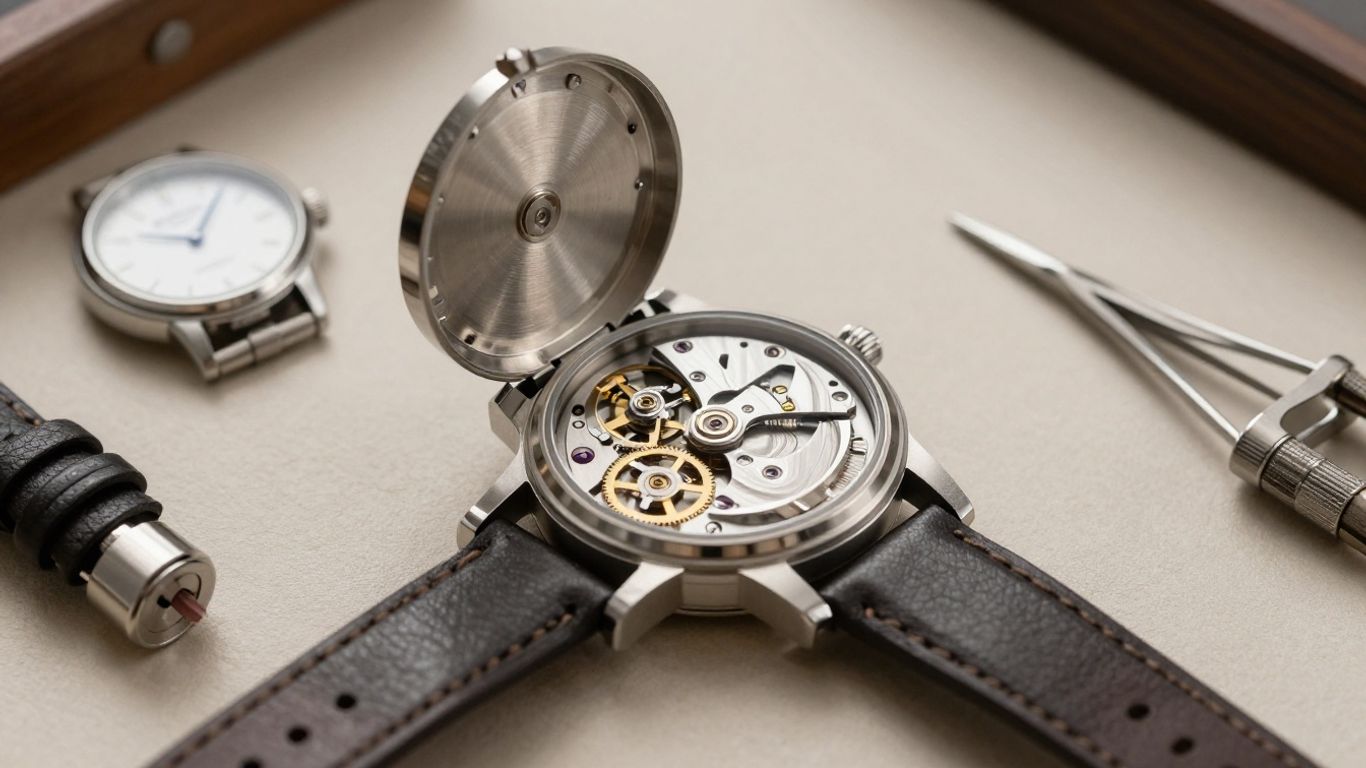
Key Takeaways
A watch movement is the mechanism that stores energy, releases it at a controlled rate and turns that energy into moving hands or a digital display. Once you understand the differences, choosing a watch becomes less about hype and more about how you actually want to wear it.
- Quartz movements are usually the most accurate and convenient.
- Mechanical movements use a mainspring rather than a battery.
- Automatic movements are mechanical watches wound by a moving rotor.
- Servicing, water resistance and magnetism affect long-term reliability.
- The best movement depends on your habits, priorities and tolerance for upkeep.
What a watch movement actually does
A watch movement is the working mechanism inside the case. It receives energy, controls its release and uses that process to indicate the time. These watch movement basics give you a useful starting point before you compare brands, complications or prices.
The movement versus the watch case
The case is the outer shell that holds and protects the movement, dial and hands. It may be made from steel, titanium, ceramic or another material, but it does not keep time itself. The movement sits inside it, connected to the crown and display through small mechanical or electronic components.
A well-made case can improve water resistance and everyday protection, while a well-designed movement determines how the watch runs. Treating those as separate parts helps you judge a watch more clearly rather than assuming an impressive case tells you everything.
How energy becomes accurate time
Every movement needs an energy source. In a mechanical watch, a wound mainspring stores that energy; in a quartz watch, a battery powers an electronic circuit. The movement then releases energy in carefully measured steps so the hands or display advance at a predictable rate.
Accuracy depends on how consistently that energy is regulated. Temperature, position, shock, magnetism, manufacturing tolerances and the condition of the movement can all influence performance, which is why two watches with the same broad movement type may not behave identically.
The main parts every beginner should know
You do not need to memorise every component to understand a movement. A few names explain most of what you see in a basic mechanical design: the mainspring stores energy, the gear train transfers it, and the escapement controls its release.
The balance wheel and hairspring act as the regulating organ, while jewels reduce friction at selected pivot points. In a quartz movement, the crystal, circuit and stepper motor take over much of the timing and hand-driving work.
Why the movement matters to owners
The movement affects how often you set the watch, how it feels to operate and what kind of maintenance it may need. It also shapes the personality of the watch: a mechanical movement can invite closer appreciation of craft, while quartz tends to disappear into the background and simply do its job.
That does not make one type automatically better. The practical difference is ownership: your daily routine, patience with winding and willingness to pay for servicing matter more than a movement label on its own.
The three main types of watch movements
Most watches fall into a few broad movement families, although modern designs can blur the boundaries. Quartz, manual-wind mechanical and automatic mechanical movements each make a different compromise between convenience, involvement and engineering character. Learning those differences makes product descriptions much easier to interpret.
Quartz movements and battery-powered accuracy
A quartz movement uses a battery or another electrical power source to energise a quartz crystal. The crystal vibrates at a consistent frequency, and an electronic circuit uses that frequency to measure time before a motor moves the hands or a display updates.
Quartz watches are generally straightforward to live with. They often keep time closely, need little day-to-day attention and continue running while you leave them in a drawer, provided the battery has charge.
Mechanical movements and manual winding
A manual-wind mechanical movement stores energy in a mainspring that you wind through the crown. As the spring unwinds, gears transfer its energy to the hands while an escapement and balance regulate the release.
You need to wind this type of watch periodically, depending on its power reserve and how often you wear it. That routine can be part of the appeal, especially if you enjoy the tactile relationship between the crown and the mechanism.
Automatic movements and self-winding rotors
An automatic movement is a mechanical movement with a rotor that turns as you move your wrist. Through a winding system, that motion replenishes energy in the mainspring. The watch still relies on the same basic mechanical principles as a manual-wind design.
An automatic watch can stop if it is left unused long enough for its stored energy to run down. It offers less regular crown winding during wear, but it is not maintenance-free and it remains sensitive to the same general issues as other mechanical watches.
Hybrid and specialized movement designs
Some movements combine electronic timing with mechanical components, while others add functions such as a chronograph, calendar, alarm or a second time zone. These designs can be useful, but extra functions usually mean more parts to understand and potentially service.
Read the description for what the movement actually does rather than relying on a fashionable label. “Hybrid” is a broad term, so the power source, display type and operating instructions are more informative than the name alone.
How mechanical watch movements work
A mechanical watch turns stored spring tension into controlled motion. It does this through a chain of components that must work in the correct order and with very small tolerances. The result is a compact machine that can keep time without a battery, though it needs suitable care.
The mainspring as the power source
When you wind a mechanical watch, the crown tightens a coiled mainspring inside the barrel. The spring then tries to unwind, creating the force that drives the movement. A slipping bridle in an automatic watch can allow winding to continue without simply forcing the spring past its limit.
The available energy is finite. As the spring unwinds, the movement must manage its changing force so the watch remains reasonably consistent until the power reserve ends.
The gear train that drives the hands
The gear train passes energy from the mainspring towards the escapement and hands. Each wheel turns at a different rate, allowing the movement to translate the relatively slow release of stored energy into the familiar motion of seconds, minutes and hours.
The wheels also connect to the display works, which position the hands and allow the crown to set them. Because the gear train is delicate, forcing the crown or hands at the wrong time can create unnecessary strain.
The escapement and balance wheel
The escapement acts like a gate between the gear train and the regulating system. It releases small amounts of energy at measured intervals, while the balance wheel swings back and forth with the hairspring and establishes the movement’s rhythm.
This is where a mechanical watch’s rate is controlled. Changes in temperature, shocks, magnetism or the watch’s position can alter that rhythm, so mechanical accuracy is a matter of careful regulation rather than a single fixed electronic signal.
Jewels, lubrication, and friction control
Synthetic jewels are placed at selected points where rotating pivots would otherwise create substantial friction. They do not make a movement indestructible, but they help reduce wear when properly finished and lubricated.
Oils can dry, spread or become contaminated over time. For that reason, a mechanical movement needs professional attention eventually, even if it appears to be running normally. Good servicing is about preserving clean contact between parts, not merely restarting a stopped watch.
How automatic watches differ from manual-wind watches
Automatic and manual-wind watches belong to the same mechanical family. Their key difference is how the mainspring receives energy: you wind a manual watch directly through the crown, while an automatic watch uses movement from your wrist to wind it. That distinction affects convenience, thickness and the way you interact with the watch.
What the rotor does
The rotor is a weighted component that swings as the watch moves. Its rotation turns a winding mechanism, which transfers energy to the mainspring. In many watches, the rotor can wind in one direction or both directions depending on the design.
You may see the rotor through an exhibition caseback, where it becomes part of the visual appeal. Its presence also means an automatic movement has additional components compared with a similarly sized manual-wind movement.
How wrist movement winds the mainspring
As you walk, gesture or change position, the rotor responds to gravity and inertia. The winding system converts that movement into tension in the mainspring. Wearing the watch regularly can therefore keep it running without frequent direct winding.
The amount of winding depends on your activity, the movement and the condition of its winding system. Ordinary wrist movement is generally enough to help, but wearing an automatic watch does not guarantee that it will remain fully wound.
When an automatic watch still needs manual winding
An automatic watch may need manual winding after it has stopped, after a long period in storage or if your routine involves little wrist movement. You normally wind it through the crown according to the maker’s instructions, then set the time if necessary.
Avoid treating the crown as a test of strength. If it feels rough, catches or resists unexpectedly, stop and have the watch checked rather than continuing to turn it.
Power reserves and watch winders
A power reserve describes how long a fully wound mechanical watch can run without receiving more energy. Once that reserve is exhausted, you need to wind and set the watch again unless regular wear has kept it going.
A watch winder can rotate an automatic watch while it is off your wrist, but it is not essential for every owner. If you do not mind resetting the watch, simple storage is often the less complicated option. A winder should suit the movement and be used for convenience, not because the watch cannot otherwise be cared for.
Understanding quartz watch movements
Quartz changed everyday watch ownership by making accurate timekeeping easier to produce and maintain. The movement uses electricity and a vibrating crystal instead of a mainspring and balance wheel. That basic arrangement can power anything from a simple three-hand display to a feature-rich digital watch.
How a quartz crystal keeps time
A quartz crystal responds to an electrical charge by vibrating at a predictable frequency. The circuit counts those vibrations and converts them into regular electrical pulses. In an analogue watch, those pulses activate a stepper motor that advances the hands.
The crystal is not a battery and does not provide the energy itself. It provides a stable reference for the circuit, while the battery supplies the power needed to operate the system.
Analog, digital, and multifunction quartz movements
Analogue quartz watches show time with hands, while digital quartz watches use a liquid-crystal or similar electronic display. Multifunction designs may add calendars, alarms, timers or other indications, depending on the movement.
More functions can be handy, but they can also make the controls less intuitive. Before buying, consider whether you will use those features or whether a simple display would better suit your routine.
Battery life and replacement timing
A quartz watch continues to run until its battery is depleted or another part needs attention. Battery life varies by movement, display and functions, so you should follow the manufacturer’s guidance rather than assume one universal replacement interval.
Do not leave a dead battery inside a watch indefinitely. A qualified watchmaker or service centre can replace it and check the seal, particularly if the watch is intended for regular contact with water.
Why quartz watches are usually more accurate
Quartz crystals provide a very consistent reference, and the electronic circuit is less affected by the small positional changes that influence a mechanical balance. That is why quartz watches are usually more accurate in everyday use.
“Usually” still matters. Temperature, battery condition, impact and the quality of the circuit can affect performance. Quartz is not magic; it is simply a timing system that generally demands less adjustment from you.
How to compare movements before buying
A movement comparison is most useful when you connect specifications to your own habits. Ask whether you want the watch to run unattended, whether winding sounds enjoyable or tiresome, and how you feel about future servicing. Price alone does not answer those questions.
Accuracy, power reserve, and convenience
Quartz is often the practical choice if you want to pick up a watch and see close-to-correct time with minimal effort. Manual-wind watches ask you to create a winding routine, while automatic watches can reduce that task when worn regularly but still have a finite power reserve.
The right compromise depends on what you notice. Some owners value seconds of precision; others value the ritual of winding or the movement’s visible workmanship more highly.
Maintenance costs and service intervals
Every movement needs some form of care, although the timing and type differ. Mechanical watches have more moving parts that depend on lubrication and adjustment, while quartz watches may need battery replacement and attention to seals or electronic components.
Use the maker’s service guidance as a starting point and pay attention to how the watch behaves. A movement that is losing time, stopping or showing damage may need attention sooner than a calendar reminder suggests.
Durability for everyday wear
Durability comes from the whole watch, not just the movement. Case construction, crystal, crown design, water resistance and how you use the watch all matter. A movement designed for daily wear can still suffer if it is exposed to avoidable shocks, strong magnetic fields or moisture.
For a practical comparison, consider these everyday questions before you buy:
- Will you wear the watch during work, exercise or travel?
- Are you comfortable winding or resetting it when it stops?
- Can you keep it away from strong magnets and sudden impacts?
- Are you prepared for battery changes or mechanical servicing?
These questions often reveal a better match than a long list of technical terms. A watch that fits your routine is more likely to be worn and looked after.
Choosing based on style and watch ownership habits
Choose a mechanical movement if the experience of winding, listening and looking closely at the mechanism is part of the appeal. Choose quartz if you prefer low-effort reliability and do not want the watch to demand much attention. Automatic sits between those preferences, adding mechanical character while reducing routine winding during regular wear.
There is no virtue in choosing a movement you will find irritating. Your watch should support the way you live, whether that means a quiet tool on your wrist or a small piece of engineering you enjoy interacting with.
Common watch movement problems and care tips
Most movement problems develop through a combination of age, moisture, impact, magnetism or neglected maintenance. You can reduce the risk without becoming a watch technician. Basic care starts with recognising what the movement dislikes and knowing when to seek help.
What magnetism and shocks can do
Magnetism can affect the hairspring in a mechanical watch, causing it to run unusually fast or behave inconsistently. Strong impacts can disturb delicate pivots, damage the balance staff or affect the hands and dial. Quartz watches are not immune to every form of damage either, particularly when a hard shock affects the circuit or motor.
Keep a watch away from strong magnetic sources where practical, and remove it before activities likely to involve sharp impacts. If its rate changes suddenly after contact with a magnet or a knock, arrange an assessment rather than trying to regulate it yourself.
Signs a movement needs servicing
A watch that repeatedly stops, gains or loses noticeably more time than usual, makes an unfamiliar sound or shows difficulty winding may need professional attention. Moisture beneath the crystal is another warning sign, not something to watch casually.
Do not wait for a complete failure if the symptoms persist. Early inspection may identify a worn seal or contaminated lubricant before the problem spreads through the movement.
Safe storage and winding habits
Store a watch somewhere dry and reasonably stable, away from intense heat, magnets and unnecessary knocks. When winding or setting it, use gentle, even pressure and follow the instructions for the particular movement.
A few simple habits make everyday care easier:
- Keep the crown pushed in or screwed down when the design requires it.
- Do not wind or set the watch with excessive force.
- Store a stopped mechanical watch safely rather than shaking it aggressively.
- Have unusual resistance, noises or timekeeping changes checked.
Those habits are modest, but they prevent many avoidable mistakes. They also help you notice changes while they are still useful clues rather than evidence of a larger failure.
Water resistance and movement protection
Water resistance is a property of the complete watch and its seals, not a permanent guarantee. Gaskets age, crowns may not be closed correctly and a case can lose resistance after impact or opening. Even a watch marked as water resistant should be treated according to its stated limits.
If you see condensation under the crystal or know that water has entered the case, stop using the watch and seek qualified help promptly. Drying the outside will not remove moisture that has reached the movement.
Frequently Asked Questions
What is a watch movement?
A watch movement is the mechanism inside a watch that stores or receives energy, regulates its release and drives the time display.
Are automatic and mechanical watches the same thing?
An automatic watch is a type of mechanical watch. The distinction is that an automatic model uses a rotor to wind its mainspring, while a manual-wind model is wound directly through the crown.
Which watch movement is most accurate?
Quartz movements are generally more accurate in everyday use than mechanical movements, although performance varies with the quality, condition and environment of the particular watch.
How often does a mechanical watch need winding?
It depends on the movement’s power reserve and how often you wear it. A manual watch needs direct winding, while an automatic watch may stay wound through regular wrist movement.
Can an automatic watch be overwound?
Many modern automatic watches use a slipping mechanism that helps prevent the mainspring from being forced beyond its winding limit. You should still follow the maker’s instructions and stop if the crown feels abnormal.
Why has my watch suddenly started running fast?
Possible causes include magnetism, a shock, a change in position or a mechanical fault. Persistent or sudden changes should be checked by a qualified watchmaker.
Does water resistance protect the movement forever?
No. Seals age, cases can be damaged and crowns may not be secured correctly. Water resistance should be checked periodically and treated as a limit, not a permanent promise.