Key Takeaways
A watch movement is the mechanism that creates and measures the passage of time. Once you understand how it receives power, you can judge a watch on more than appearance or marketing language.
- Mechanical movements store energy in a wound mainspring.
- Automatic movements are mechanical movements wound by a rotor.
- Quartz movements use a battery and vibrating crystal for accurate timekeeping.
- Accuracy, maintenance, durability, and cost vary between movement types.
- Complications add useful or decorative functions beyond basic time display.
Understanding what a watch movement does
A watch movement is the working mechanism inside the watch. It receives energy, controls how that energy is released, and turns it into the movement of the hands or display. These watch movement basics give you a useful starting point when comparing watches.
The movement versus the watch case
The case is the outer shell that protects the movement, dial, hands, and other components. It may be made from steel, titanium, ceramic, or another material, but it is not what keeps time. The movement sits inside the case, often hidden behind a solid back or visible through a display back.
A well-finished case can make a watch feel special, but it does not automatically tell you anything about the mechanism inside. When you assess value, consider the case and movement separately rather than treating the watch as one undivided object.
How power becomes timekeeping
Every watch needs a power source and a regulating system. In a mechanical watch, stored spring energy travels through gears before an escapement releases it in measured intervals. In a quartz watch, electrical energy drives a circuit and motor that move the hands.
The basic chain is straightforward: energy enters the movement, the regulating element controls its release, and the gear train transfers that motion to the display. Small differences in design and adjustment affect accuracy, service needs, and how the watch feels to use.
The main parts inside a movement
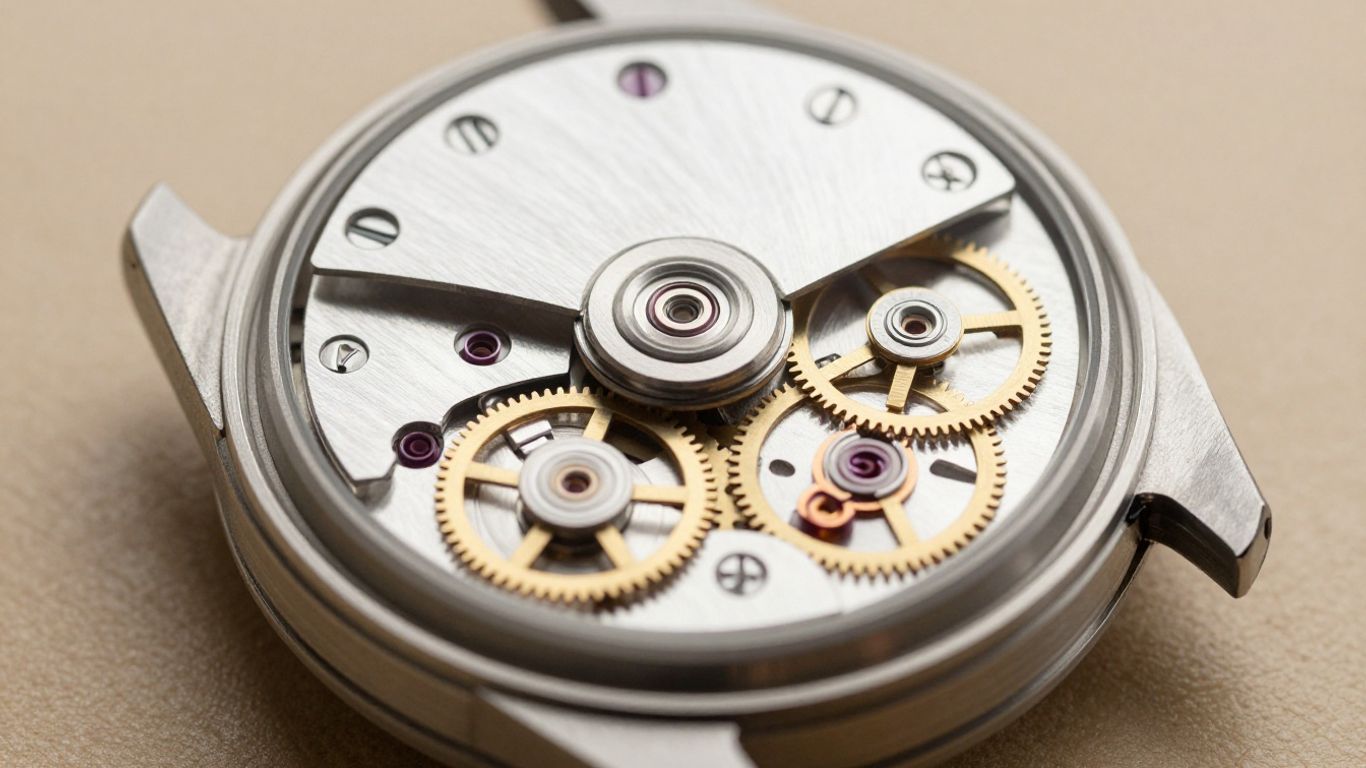
Mechanical movements contain several recognisable groups of parts. The mainspring stores energy, the gear train carries it, and the escapement controls its release. The balance wheel and hairspring then provide the regular oscillation used to regulate the watch.
Quartz movements arrange the work differently, using a battery, electronic circuit, quartz crystal, and stepping motor. You do not need to memorise every component to compare watches sensibly; knowing which parts supply, regulate, and transfer energy is usually enough.
Why movement quality matters
Movement quality affects more than a specification sheet. It can influence how consistently a watch keeps time, how long it runs between winding or battery changes, how easy it is to service, and how pleasant it is to operate. The mechanism shapes ownership as much as the case and dial do.
That does not mean the most complicated movement is automatically the best choice. A simple quartz watch may suit you better than an elaborate mechanical one if dependable accuracy and low upkeep matter most.
Exploring mechanical watch movements
A mechanical movement runs without a battery. It relies on stored spring energy and a carefully coordinated system of gears, an escapement, and a balance wheel. This traditional arrangement is valued for its physical craft and the way it makes timekeeping visible as a mechanical process.
How a mainspring stores energy
When you wind a mechanical watch, the crown turns a system that coils the mainspring inside its barrel. The spring holds that energy and gradually releases it as it unwinds. The gear train passes the energy onward at controlled rates.
The length of time a watch runs after winding is called its power reserve. It depends on the movement and its design, so two mechanical watches may need winding at noticeably different intervals.
The role of the balance wheel and escapement
The escapement acts as a gate between the stored energy and the gear train. It releases energy in small steps, while the balance wheel oscillates back and forth to provide a regular rhythm. The hairspring helps return the balance wheel through each cycle.
This is why a mechanical watch can appear to have a smoothly active life even when it is sitting on your wrist. The system is constantly exchanging stored energy for controlled motion, although small changes in position, temperature, and condition can affect its rate.
Manual-wind movements explained
A manual-wind movement requires you to wind the mainspring through the crown. As the spring loses energy, you wind the watch again, making the routine part of wearing it. Some people enjoy this daily interaction because it creates a direct connection with the mechanism.
The trade-off is easy to understand: if you forget to wind the watch, it may stop. That is not a fault in the basic design; it is simply the way a hand-wound movement receives its power.
Strengths and trade-offs of mechanical watches
Mechanical watches can offer detailed finishing, a tactile winding experience, and a long service life when properly cared for. They can also be more sensitive to knocks, magnetism, moisture, and changes in position than a simple quartz watch. Their appeal is often emotional as well as practical.
Before choosing one, consider the habits that come with it:
- You may need to wind a manual watch regularly.
- Mechanical accuracy is usually discussed as a range rather than perfect precision.
- Servicing involves specialised work and can cost more than replacing a battery.
- The movement can reward careful handling and regular wear.
These points do not make mechanical watches unsuitable. They simply describe the exchange: you accept more involvement in return for a traditional, finely coordinated mechanism.
Breaking down automatic movements
An automatic movement is a type of mechanical movement. It still uses a mainspring, gear train, escapement, and balance wheel, but it can wind itself through the movement of your wrist. The term describes how the spring receives energy, not a completely separate kind of timekeeping.
How a rotor winds the mainspring
An automatic watch contains a weighted rotor that swings as your wrist moves. Through gears and a winding system, that motion winds the mainspring. The rotor can move in response to ordinary daily activity, although the amount of winding depends on how the watch is worn.
The rotor does not create unlimited power. Once the spring is fully wound, the movement has a system to prevent excess winding, while the watch continues using stored energy as it runs.
Automatic versus manual-wind watches
Both movements rely on a mainspring and mechanical regulation. The key difference is that an automatic watch has a rotor to add energy, while a manual-wind watch relies on you turning the crown. Their underlying approach to timekeeping is therefore closely related.
An automatic watch may suit you if you wear the same watch often and prefer not to wind it by hand. A manual-wind model may appeal more if you enjoy a quieter, deliberate ritual and a movement without a rotor.
What happens when an automatic watch stops
An automatic watch stops when its stored energy has run down. This can happen if you leave it off your wrist long enough, even if it was working normally beforehand. You generally need to wind it and set the time again before wearing it.
A watch that stops after sitting unused is behaving as designed. If it stops repeatedly while being worn, or loses time noticeably, it may need assessment by a qualified watchmaker rather than simply more wrist movement.
Common benefits and drawbacks
Automatic watches offer the convenience of wrist-powered winding and the character of a mechanical mechanism. They can be satisfying to wear, particularly when the rotor and balance can be seen through a display back. They also bring the same general sensitivity and service requirements associated with mechanical watches.
For everyday use, ask whether you will wear the watch often enough to keep it running and whether you are comfortable with periodic servicing. If you rotate several watches, you may find that every automatic model still needs resetting after time in storage.
Understanding quartz movements
Quartz movements use electricity rather than a wound mainspring as their primary source of power. A battery sends energy through an electronic circuit, and the movement converts that energy into regular pulses for the display. This design is common because it can be accurate, practical, and relatively simple to maintain.
How a battery powers a quartz watch
The battery supplies a small electrical current to the quartz movement. The circuit uses that current to make the crystal vibrate and sends measured pulses to a stepping motor. The motor turns the gear train, which moves the hands around the dial.
When the battery is depleted, the watch usually stops or shows a low-power indication, depending on its design. Battery replacement is generally a straightforward maintenance task, though the case should be closed carefully to preserve its protection against moisture.
The role of the quartz crystal
Quartz has a useful property called piezoelectricity: when an electrical current is applied, the crystal vibrates at a consistent frequency. The circuit counts those vibrations and uses them as a reference for the passage of time.
The crystal is not powering the watch by itself. The battery provides the energy, while the quartz crystal supplies a stable timing reference. That division of labour is central to how a quartz movement works.
Why quartz watches are so accurate
Quartz movements can keep time consistently because the crystal vibrates at a very regular rate. The electronic circuit can count those vibrations more steadily than the balance system in many mechanical movements. Temperature, age, battery condition, and the quality of the movement can still affect performance.
For you, the practical result is usually less need to reset the watch during ordinary use. Accuracy remains only one consideration, however; a watch can be technically precise and still feel wrong for your style, habits, or expectations.
Comparing quartz durability, cost, and maintenance
Quartz watches often have fewer moving mechanical parts and are commonly less expensive to buy and maintain. They may be a sensible choice if you want a watch that can sit in a drawer, restart after a battery change, and keep dependable time without regular winding.
That simplicity does not make every quartz watch disposable. Cases, seals, crystals, batteries, and electronic components still need care, and a damaged movement may sometimes be replaced rather than repaired. The sensible choice depends on the watch’s construction and the service available for it.
Comparing movement types side by side
The three labels are easier to compare once you separate their power systems from their appearance. Manual-wind and automatic watches are both mechanical, while quartz uses an electronic regulator. Your decision should follow how you will wear and care for the watch, not just which movement sounds more prestigious.
Accuracy and everyday timekeeping
Quartz is generally chosen when straightforward, consistent timekeeping is the priority. Mechanical watches can also keep useful time, but their rate may vary with position, wear, condition, and adjustment. The difference is most noticeable when you compare a watch with a phone or another precise clock over several days.
A mechanical watch’s appeal is not erased by that difference. Many owners accept some variation because they value the movement’s craft and the experience of wearing it.
Power reserves and battery life
Power reserve describes how long a mechanical watch can run after its mainspring has been wound. Quartz watches instead rely on battery life, which varies according to the movement, battery, and functions used. An automatic watch can keep winding while worn, but it will eventually stop if left still for long enough.
The comparison below gives you a practical first pass rather than a promise about every model.
| Movement type | Main power source | What happens when unused | Typical care pattern |
|---|---|---|---|
| Manual-wind mechanical | Wound mainspring | Runs down and stops | Regular winding and periodic servicing |
| Automatic mechanical | Rotor-wound mainspring | Runs down and stops | Wear, occasional winding, and servicing |
| Quartz | Battery | Usually keeps running until the battery depletes | Battery changes and seal checks |
Use the table as a guide to ownership rather than a ranking. A movement that matches your routine will usually feel more valuable than one chosen solely for its reputation.
Maintenance and repair needs
Mechanical movements contain many moving parts that need cleaning, lubrication, and adjustment over time. Quartz movements generally need less routine attention, but they are not maintenance-free. Any watch can suffer from worn seals, moisture, impact, or neglect.
When buying, check whether the maker or a qualified watchmaker can service the movement. Easy access to competent care is part of a watch’s practical value and can matter more than a decorative feature.
Choosing based on lifestyle and budget
Choose manual-wind if you enjoy a daily ritual and do not mind winding the watch. Choose automatic if you wear one watch frequently and like the idea of wrist-powered winding. Choose quartz if accuracy, convenience, and lower ongoing involvement are your main priorities.
Budget should include more than the purchase price. Consider batteries, servicing, straps, water-resistance checks, and the likelihood that you will actually wear the watch. A less expensive watch that suits your routine can be the better value.
Learning key movement features and complications
A complication is a function beyond basic hours, minutes, and seconds. Some are genuinely useful, while others mainly add visual interest and mechanical complexity. Learning what each feature does helps you judge whether it earns its place on the dial.
Power reserve indicators
A power reserve indicator shows how much running time remains in a mechanical watch before the mainspring needs winding. It may appear as a small hand, a window, or another display. The feature is particularly useful when you do not wear the watch every day.
It does not extend the power reserve. Instead, it gives you a clearer view of the energy already stored, helping you decide when winding is needed.
Chronographs and stopwatch functions
A chronograph is a stopwatch function built into a watch. It commonly uses pushers to start, stop, and reset a separate timing display while the regular time continues. The sub-dials and hands can make the dial busier, so legibility matters.
You should also distinguish a chronograph from a chronometer. The first describes a timing function; the second generally refers to a watch meeting a defined accuracy standard. They are not interchangeable terms.
Date displays and moon-phase complications
A date display shows the calendar date, often through a window or additional hand. Depending on the movement, you may need to correct it after months with fewer than the full number of days or after the watch has stopped.
A moon-phase complication tracks the changing appearance of the moon through a dedicated display. It is not essential for daily timekeeping, but it can add charm and demonstrate the movement’s ability to coordinate another cycle.
Water resistance and movement protection
Water resistance comes from the case, crystal, crown, case back, and seals working together. It is not a special property of the movement alone. Resistance can also decline as seals age or after the case has been opened.
Treat the rating as guidance for intended conditions, not as a permanent guarantee. Keep the crown secured, avoid operating controls underwater unless the instructions allow it, and have the seals checked when appropriate. Moisture inside the case can damage delicate components quickly.
Frequently Asked Questions
What is a watch movement?
A watch movement is the mechanism inside a watch that receives energy, regulates it, and drives the time display.
Are automatic and mechanical watches the same?
An automatic watch is a type of mechanical watch. The difference is that an automatic movement uses a rotor to wind its mainspring, while a manual movement is wound through the crown.
Which movement keeps time most accurately?
Quartz movements are generally selected for dependable everyday accuracy. Mechanical accuracy varies according to the movement, adjustment, condition, position, and temperature.
How long does an automatic watch run when unworn?
It runs until the energy stored in its mainspring is depleted. The exact running time depends on the movement, so it varies between watches.
Does a quartz watch need servicing?
Quartz watches need battery changes and may need checks of their seals and case. A damaged or ageing electronic movement may require replacement rather than traditional mechanical repair.
Why do mechanical watches need servicing?
Their moving parts require cleaning, lubrication, and adjustment over time. Servicing also gives a watchmaker a chance to inspect wear and replace parts when necessary.
What does a chronograph do?
A chronograph provides a stopwatch function, allowing you to start, stop, and reset a separate elapsed-time display while the watch continues showing the current time.