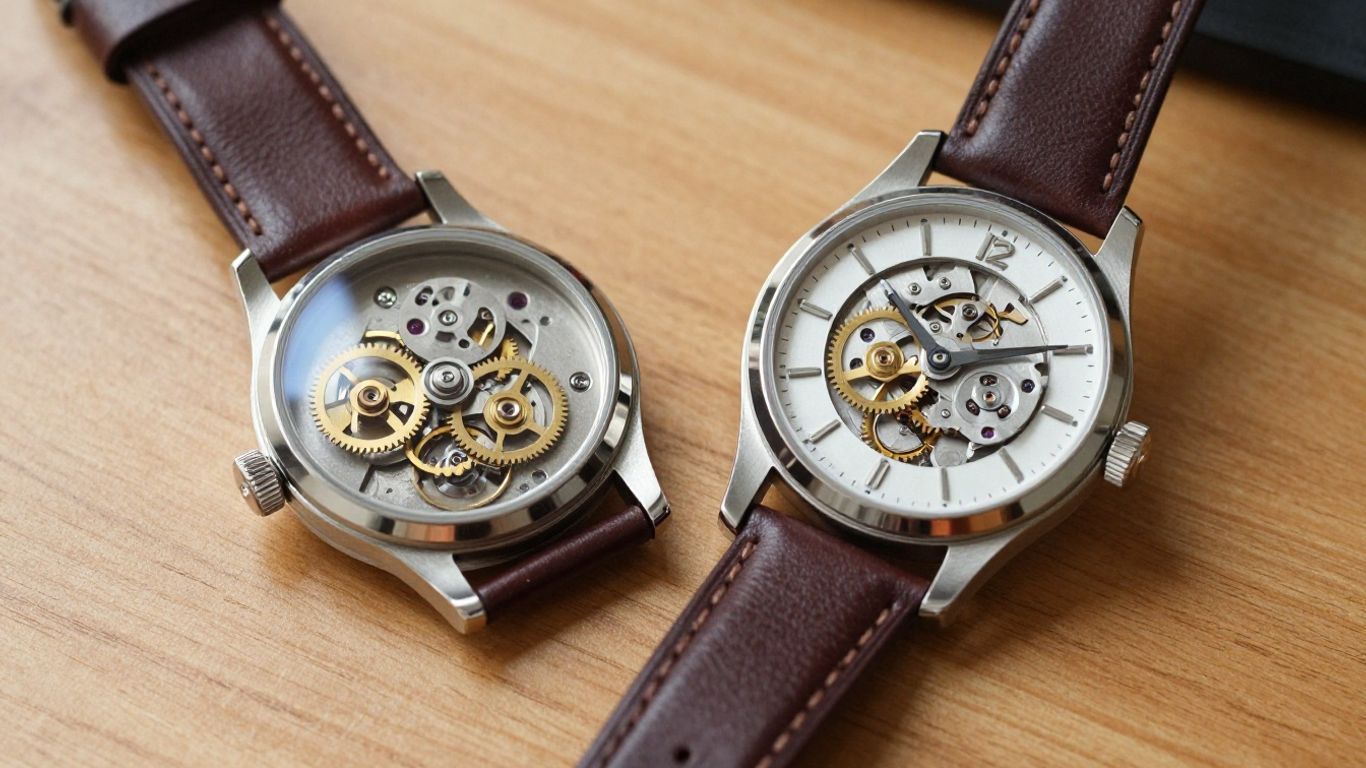
Key Takeaways
A watch movement is the mechanism that turns stored or supplied energy into steady movement of the hands. Understanding the basics makes it easier to choose a watch for your habits rather than its marketing language.
- Quartz movements use a battery and crystal-controlled electronic timing.
- Mechanical movements use a mainspring, gears, escapement, and balance wheel.
- Automatic movements are mechanical watches wound by the motion of your wrist.
- Accuracy, maintenance, price, and personal enjoyment all matter when comparing movements.
- Sensible care helps protect any movement from moisture, shocks, and neglect.
What a watch movement actually does
A watch movement is the working mechanism inside the case. It controls how energy is stored, released, and translated into the motion of the hands, whether that energy comes from a battery or a wound spring. These watch movement basics are useful because the movement affects how you use, maintain, and value the watch.
The movement as the watch’s engine
Think of the movement as the watch’s engine, although it is much smaller and designed for a very different job. It supplies controlled power to the hands and, where fitted, to features such as a date display or chronograph. The case protects this mechanism, while the dial lets you read the result.
A movement does not simply make the hands spin continuously. It releases energy in carefully measured steps, creating the familiar movement of a seconds hand or the less obvious progress of the minute and hour hands. In a mechanical watch, this happens through a series of springs, wheels, and regulating parts; in a quartz watch, electronics control the process.
How energy becomes precise timekeeping
Every movement needs a power source and a regulator. The power source provides energy, the gear train transfers it, and the regulating system controls the rate at which it is released. Together, these parts turn a reserve of energy into a consistent indication of time.
The regulator is where much of the practical difference between movement types appears. A quartz crystal provides a stable electronic reference, while a mechanical watch relies on the oscillation of a balance wheel and hairspring. Neither system is perfectly unaffected by its surroundings, but each is engineered to keep those effects within a useful range.
Movement, case, dial, and complications
The movement is only one part of a complete watch. The case protects it from knocks and moisture, the dial presents the information, and the hands show the hours, minutes, and seconds. The crown connects your actions to the movement, allowing you to set the time or wind a mechanical watch.
A complication is any function beyond basic time display, such as a date, moon-phase display, second time zone, or chronograph. These additions usually require extra components and can make the movement more difficult to adjust or service. More features may be appealing, but they also give you more to understand and maintain.
Why the movement matters to owners
The movement influences daily accuracy, battery or winding habits, servicing needs, thickness, and often the price of a watch. It also shapes the experience of wearing it: a quartz watch can be wonderfully unobtrusive, while a mechanical watch invites more interaction.
That does not make one type universally better. The right movement fits your routine and your reasons for wearing a watch. If you want a dependable accessory that asks little of you, convenience may lead the decision; if you enjoy craft and mechanical detail, the movement itself may be part of the pleasure.
How quartz movements keep time
Quartz movements use electricity and a vibrating quartz crystal to regulate timekeeping. They became popular because they can be accurate, practical, and relatively easy to live with. For many people, quartz is the sensible choice when a watch needs to work without regular winding.
The battery and electronic circuit
A small battery supplies power to an electronic circuit. The circuit sends controlled electrical pulses to a motor, which turns the gears and moves the hands around the dial. In digital quartz watches, the circuit can instead send the timing information to a display.
Battery life varies with the movement and the watch’s features, so it is better to follow the maker’s guidance than to assume a fixed replacement schedule. A chronograph, alarm, or backlight can place different demands on a battery than a simple three-hand watch.
The quartz crystal and timing signal
Quartz has useful piezoelectric properties: when an electrical charge is applied, the crystal vibrates at a very consistent frequency, and that vibration can also produce an electrical signal. The circuit counts those oscillations and converts them into regular pulses for the motor.
This process replaces the mechanical balance wheel as the main timekeeping reference. The crystal is small and hidden inside the movement, but it is the reason a quartz watch can keep a steady rhythm without a mainspring or rotor.
Why quartz watches are so accurate
Quartz crystals vibrate at a stable frequency, and electronic circuits can count that frequency precisely. As a result, a quartz movement will generally vary less in everyday use than a mechanical movement, although temperature, battery condition, magnetism, and the quality of the movement still matter.
Accuracy is not the same as permanence. A quartz watch may keep excellent time while its battery is healthy, yet stop when the battery is depleted. It still needs occasional attention, particularly if the case seals or battery compartment require inspection.
Common quartz advantages and drawbacks
Quartz watches are often thin, light, affordable, and straightforward. They can suit you well if you want to put a watch on, set it, and get on with your day without thinking about winding or wearing it continuously.
Their drawbacks are mostly about preference and maintenance rather than basic function. Some owners miss the visible craftsmanship of a mechanical movement, while others dislike replacing batteries or dealing with a watch that has stopped after being left in a drawer.
How mechanical movements work
A mechanical movement stores energy in a wound spring rather than a battery. It releases that energy through a train of gears, while an escapement and balance assembly regulate the rate. The result is a small machine that can run for hours or days, depending on its power reserve.
The mainspring and power reserve
When you wind a mechanical watch, the crown turns a system that tightens the mainspring. The spring then gradually unwinds, releasing energy through the movement. The length of time it can run before stopping is called the power reserve.
Power reserve depends on the movement and its design. When the reserve is exhausted, the watch stops until you wind it again or, in the case of an automatic watch, wear it enough for the rotor to replenish the spring.
The gear train and escapement
The gear train carries energy from the mainspring towards the hands. Different wheels rotate at different speeds, allowing the movement to turn the seconds, minutes, and hours hands at their required rates.
The escapement sits between the gear train and the regulating assembly. It releases the train in small, controlled increments instead of allowing the spring to unwind all at once. This controlled release is what gives a mechanical watch its characteristic ticking or sweeping motion, depending on the design.
The balance wheel and hairspring
The balance wheel oscillates back and forth, while the hairspring helps return it towards its regular position. Together they act as the movement’s regulator, controlling how frequently the escapement releases energy.
Small changes in position, temperature, magnetism, lubrication, and wear can affect this system. That is why mechanical watches can gain or lose time and why adjustment and servicing are part of owning one, rather than signs that it has failed.
Why mechanical watches need regular winding
A manually wound mechanical watch needs you to turn the crown periodically. This is a simple ritual, but it means the watch is not entirely self-sufficient: leave it unwound for long enough and it will stop.
Regular winding also gives you a feel for the crown and the movement. You should stop rather than force the crown if it becomes unusually tight, and avoid winding roughly. If the watch has a screw-down crown, make sure it is secured correctly after setting or winding.
Automatic movements explained
An automatic movement is a mechanical movement with a winding system that uses the wearer’s movement. It still relies on a mainspring, gear train, escapement, balance wheel, and hairspring. The difference is that a rotor can add energy to the mainspring as your wrist moves.
How the rotor winds the mainspring
The rotor is a weighted component that turns as the watch changes position. Through a winding mechanism, that motion tightens the mainspring. Depending on the design, the system can wind in one direction or in both directions of rotor movement.
The rotor does not create unlimited power. It works best when the watch is worn and moving regularly, and the movement includes safeguards to prevent the mainspring from being wound beyond its useful limit. If the watch spends most of its time still, the reserve will eventually run down.
Manual winding versus automatic winding
Manual and automatic watches are both mechanical, but they ask different things of you. A manual watch needs deliberate winding through the crown, while an automatic watch can replenish itself through wrist movement and can often also be wound by hand.
Neither approach is automatically more refined. Manual winding can make the mechanism feel more direct and may allow a slimmer design, while an automatic watch can be convenient if you wear it frequently. Your preference may come down to whether interaction feels enjoyable or like another task.
What happens when an automatic watch stops
An automatic watch stops when its mainspring has released its available energy. This commonly happens when you leave it on a bedside table or in a drawer for longer than its power reserve. Nothing mysterious has occurred; it simply needs to be wound and set again.
To restart it, follow the maker’s instructions for winding and setting. If it stops unusually quickly after being fully wound and worn, or refuses to start, it may need attention from a qualified watchmaker rather than repeated winding.
When an automatic movement makes sense
An automatic movement can suit you if you wear the same watch often and enjoy the connection between movement and mechanism. It may also appeal if you value traditional construction, a visible sweep of the seconds hand, or the idea of wearing a small machine that does not depend on a battery.
It is less convenient if your watches rotate frequently or sit unworn for days. In that case, you may need to reset the time more often, unless you are comfortable with that small ritual or use a suitable storage arrangement.
The watch movement parts worth knowing
You do not need to memorise every wheel and bridge to understand a watch. A handful of parts explain most of what you see and feel when you wind, set, wear, or service it. Knowing their roles also makes conversations with a watchmaker clearer.
Jewels and friction reduction
Watch jewels are usually synthetic ruby or sapphire components used as bearing surfaces in a movement. They reduce friction at points where moving parts rotate and help limit wear when the movement is properly lubricated.
A higher jewel count does not automatically mean a better watch. The number needs to be considered alongside the movement’s design, finishing, reliability, and the functions it supports. It is one detail, not a complete quality rating.
The crown, stem, and winding system
The crown is the part you turn from outside the case. The stem connects it to the movement, allowing you to wind the mainspring or adjust the hands and other displays through different crown positions.
A screw-down crown can help a water-resistant case maintain its seal when secured correctly, but it is not permission to treat the watch as indestructible. Crown tubes, gaskets, and seals can wear, and the crown should be operated gently and with clean, dry hands.
Complications beyond basic timekeeping
A date display is one of the most common complications, but watches can also show a second time zone, measure elapsed time, indicate a power reserve, or display astronomical information. Each function adds a layer of mechanical or electronic work.
Complications can make a watch more useful, more distinctive, or more enjoyable to study. They can also add thickness, cost, adjustment steps, and servicing complexity. Before choosing one, consider whether you will actually use the feature rather than simply admire the list on the specification sheet.
In-house versus outsourced movements
An in-house movement is developed and produced within the watch company’s own organisation, while an outsourced movement is obtained from a specialised external maker. The distinction can matter to collectors, but it does not settle the question of quality on its own.
An established external movement may be practical to service and widely understood by watchmakers. An in-house movement may offer a distinctive design or brand-specific approach, but it can also require more specialised knowledge. Look beyond the label and consider reliability, support, finishing, and the watch as a whole.
Quartz vs. mechanical vs. automatic
Comparing movements is less about finding a universal winner and more about matching trade-offs to your life. Quartz and mechanical are the broad categories, while automatic is a self-winding form of mechanical movement. Accuracy, maintenance, price, feel, and convenience all deserve a place in the decision.
Accuracy and everyday reliability
Quartz generally offers the most consistent everyday timekeeping, while mechanical watches are more affected by position, temperature, magnetism, and the condition of their regulation. Automatic watches share those mechanical characteristics because their winding method does not change the underlying regulator.
A mechanical watch can still be dependable, especially when properly adjusted and cared for. However, if you need the time to remain as close as possible without regular setting, quartz is usually the easier option. The difference is practical, not a judgement about craftsmanship.
A compact comparison helps separate the categories without turning the choice into a contest:
| Movement type | Power source | Main routine | Typical appeal |
|---|---|---|---|
| Quartz | Battery | Occasional battery and seal checks | Convenience and steady accuracy |
| Manual mechanical | Wound mainspring | Regular hand winding | Direct interaction and traditional craft |
| Automatic mechanical | Wound mainspring and rotor | Regular wear or manual winding | Mechanical character with less daily winding |
That table is a starting point, not a promise about every individual watch. Movement quality, regulation, construction, and your care all influence the experience, so the label should guide your questions rather than end them.
Maintenance and long-term ownership
Quartz watches usually need battery replacement and periodic checks of seals. Mechanical watches need cleaning, lubrication, regulation, and eventual servicing, although the timing depends on the movement, use, symptoms, and the maker’s guidance.
Long-term ownership also includes practical matters such as water resistance, parts availability, and access to a competent watchmaker. A cheaper watch that is difficult to service may not feel inexpensive later, while a well-supported movement can remain straightforward to own.
Price, craftsmanship, and value
Mechanical watches often cost more because they contain many small components that require assembly, adjustment, and sometimes decorative finishing. You may be paying for the movement’s construction, the case and bracelet, the maker’s design, or the pleasure of ownership rather than raw accuracy.
Quartz can offer excellent value when your priority is reliable timekeeping and low fuss. Price alone does not tell you whether a watch is right for you, and a higher price should not be treated as a guarantee of better everyday performance.
Choosing based on your lifestyle
Your habits usually provide the clearest answer. Ask yourself how often you wear a watch, whether you mind winding or resetting it, how much accuracy matters, and whether you enjoy seeing the mechanism as part of the object.
A few practical questions can narrow the choice:
- Do you want to wear the watch occasionally or most days?
- Would replacing a battery be easier for you than winding a crown?
- Are mechanical details part of the enjoyment, or merely a means to tell time?
- Will you use complications such as a date or chronograph?
If you prefer low maintenance, quartz may be the calmest fit. If you value ritual and mechanical character, manual or automatic may feel more rewarding. The best choice is the one whose demands you understand and are happy to meet.
How to care for a watch movement
Care begins with ordinary habits rather than complicated equipment. Keep the crown secured as intended, avoid unnecessary impacts, and treat water resistance as a condition that needs checking over time. Good care cannot prevent every fault, but it can reduce avoidable strain on the movement.
Protecting the movement from shocks and moisture
Large impacts can disturb delicate regulating parts, damage pivots, or affect the hands and dial. Remove a mechanical watch for activities where it may receive hard knocks, and do not assume that a sports-looking case makes the movement shockproof.
Moisture is another serious risk. Avoid operating the crown near water, keep the watch away from sudden temperature changes when possible, and have the seals checked if water resistance matters to your routine. Condensation beneath the crystal is a warning that should be dealt with promptly.
When to service a mechanical watch
A mechanical watch should be serviced according to its maker’s guidance and its actual condition. A fixed calendar is less useful than paying attention to accuracy, power reserve, winding feel, noise, and the watch’s history of use.
Service generally involves more than adjusting the hands. A watchmaker may inspect, clean, lubricate, regulate, and replace worn or damaged components. Choose a qualified professional who can explain what is required before work begins.
Replacing batteries in quartz watches
Have a quartz watch’s battery replaced by a competent technician, particularly if the case is water-resistant or uses a gasketed back. The old battery should not be left inside a watch after it has run down, since leakage can damage the movement.
Battery replacement is also a sensible moment to inspect the seals and check that the case has been closed correctly. If a quartz watch stops soon after a fresh battery is fitted, the issue may lie elsewhere in the movement and should be investigated rather than repeatedly reset.
Warning signs of movement problems
A change in behaviour is often more useful than a technical label. If the watch has suddenly become inaccurate, stops before its usual reserve, feels rough when winding, or shows moisture, arrange an inspection instead of trying to force it back into service.
Other warning signs include a loose crown, hands that stick or rub, unusual rattling, or a seconds hand that behaves erratically. Stop using the watch if continued winding or wearing could worsen the problem, and seek help from a reputable watchmaker.
Frequently Asked Questions
What is a watch movement?
A watch movement is the mechanism that powers and regulates the display of time. It may use a battery and quartz crystal, or a mainspring and mechanical regulating system.
What is the difference between quartz and mechanical movements?
Quartz movements use electronic timing powered by a battery. Mechanical movements store energy in a wound mainspring and release it through gears and an escapement.
Is an automatic watch mechanical?
Yes. An automatic watch is a mechanical watch that uses a moving rotor to wind its mainspring, although it can often also be wound manually through the crown.
How long does an automatic watch run when fully wound?
The running time depends on the movement’s power reserve. When that reserve is used up, the watch stops until it is wound or worn sufficiently to restore energy.
Are quartz watches more accurate than mechanical watches?
Quartz watches generally keep steadier everyday time because their electronic circuits use a quartz crystal as a timing reference. Mechanical watches can still perform well, but their rate is more affected by conditions and adjustment.
How often should a mechanical watch be serviced?
Follow the maker’s guidance and consider the watch’s condition, use, and service history. Changes in accuracy, winding, power reserve, or sound can indicate that an inspection is due.
Can water damage a watch movement?
Yes. Moisture can corrode or disrupt delicate components, particularly if it enters through a worn seal or an unsecured crown. Have the watch checked promptly if you notice condensation or suspect water entry.